Digital dollars for the people banks left out. The blockchain stays out of sight.
FAME is a dollar account that nobody but its owner can touch. There is no seed phrase, no gas coin and no network to pick: the blockchain does the work underneath and is never shown. One address receives USDC from eight networks and any exchange, and brings it home by itself. The money moves inside encrypted chats and savings circles, and turns into cash at a neighbour's shop, for a person with a basic phone or no phone at all. Nobody in between holds the money.
Nothing moves without you. One screen, the same password, your guardians re-sealed, your dollars with you. Your old wallet keeps withdrawing, and FAME pays the cost of the move. New accounts already open on Arc.
What FAME is for
Three things, in this order.
Utility for the excluded
Useful to the people who need it most
A person with a basic phone, or no phone, and no bank willing to serve them. FAME gives them a dollar account opened with a number, money from family abroad for half a percent, a savings club with no cash box, and cash at a neighbour's shop. That person is the reason the product exists; everything else is in service of them.
Blockchain abstraction
The chain does the work and stays out of sight
No seed phrase, no gas coin to buy, no network to choose, no address to copy. A phone number or a FAME number, a password, a fingerprint. Underneath, a smart account on Arc, fees paid in dollars by FAME's paymaster, and every movement public on a ledger nobody has to look at.
Interoperability
One account that reaches everywhere money already is
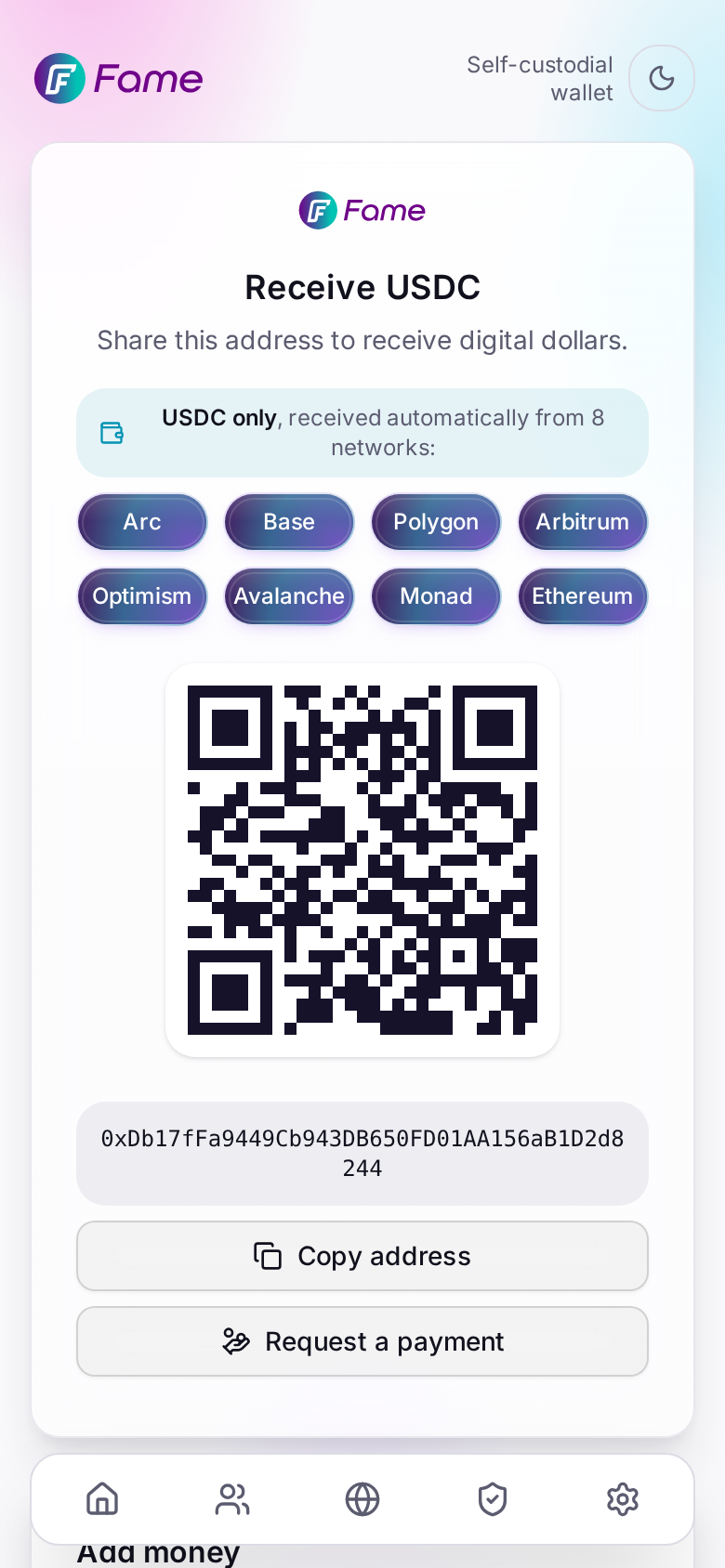
One address on eight networks. Send from any exchange, withdraw to any exchange, receive from MetaMask or a friend's wallet. Dollars sent on another network come home by themselves through Circle's own protocol: no bridge, no wrapped token, nobody holding them in between.
Who this serves
Built for the people the banks left out, and for those who send them money.
A person with no bank and no smartphone
The account is opened once on any smartphone with them present, sealed under a PIN they choose, and given a FAME number if they have no SIM. They receive dollars at that number and collect cash at a neighbour's shop. No branch, no ID queue, no app to install.
A family split by migration
The World Bank puts average remittance costs at 3 to 7%. A FAME transfer is half a percent, minimum one cent, sent from whatever exchange or wallet the money is already in, and the sender abroad is also the family's security: the guardian who brings them back in.
A savings club
Tontines, splits and fund-mes in dollars with perfect memory and no cash box: every round a direct transfer on the public record, nobody holding the pot, the whole room encrypted end to end.
A shopkeeper
Becomes the cash window their own neighbours need, earns a fee they set themselves, and never carries anyone's balance, key or debt.
An organisation paying hundreds of people
Aid, salaries, member payouts: up to 200 people in one operation, two officers' signatures, recipients with or without a phone, every line auditable on a public ledger, no distribution partner holding the funds.
Anyone who already holds USDC
On an exchange, in MetaMask, on any of eight networks: send it to one FAME address and it becomes a dollar account with people behind it, guardians for recovery and cash within walking distance.
Send from any exchange. Withdraw to any exchange. Nobody thinks about blockchains.
Your FAME address is the same on all eight networks, because it is derived from your own key. Dollars sent to it on Arc land directly. Dollars sent on any of the other seven are brought home to your account by themselves, through Circle's transfer protocol, which burns the dollars on one network and mints them on Arc: no bridge pool, no wrapped token, nobody holding money in between. A withdrawal to any of the eight shows the exact cost before you sign, and arrives in about twenty seconds.
0.5% (min $0.01) plus that network's fee, both out of the amount. Direct on Arc: no FAME fee.
Money out
0.5% plus Circle's delivery, about $0.05 on the cheap networks, shown first.
Network fees
Charged by every blockchain in its own coin (ETH, POL, AVAX, MON). FAME pays them in USDC: out of the amount on the seven, from its own paymaster on Arc.
Where the money comes from
The exchanges you already use.
The largest exchanges listed Arc within days of its launch. The ones that have not are no obstacle: withdraw on a network they support, to the same FAME address, and the dollars come home. Verified on each exchange's own pages, September 2026.
Send and receive on Arc
Withdraw from the exchange straight to your FAME address on Arc.
Receive on Arc
Deposit from FAME on Arc; fund FAME through another of the eight networks.
Through the eight networks
No Arc needed: withdraw on Base or Polygon to the same address, and it comes home.
Utility: circles
A wallet is downloaded alone. A circle is joined.
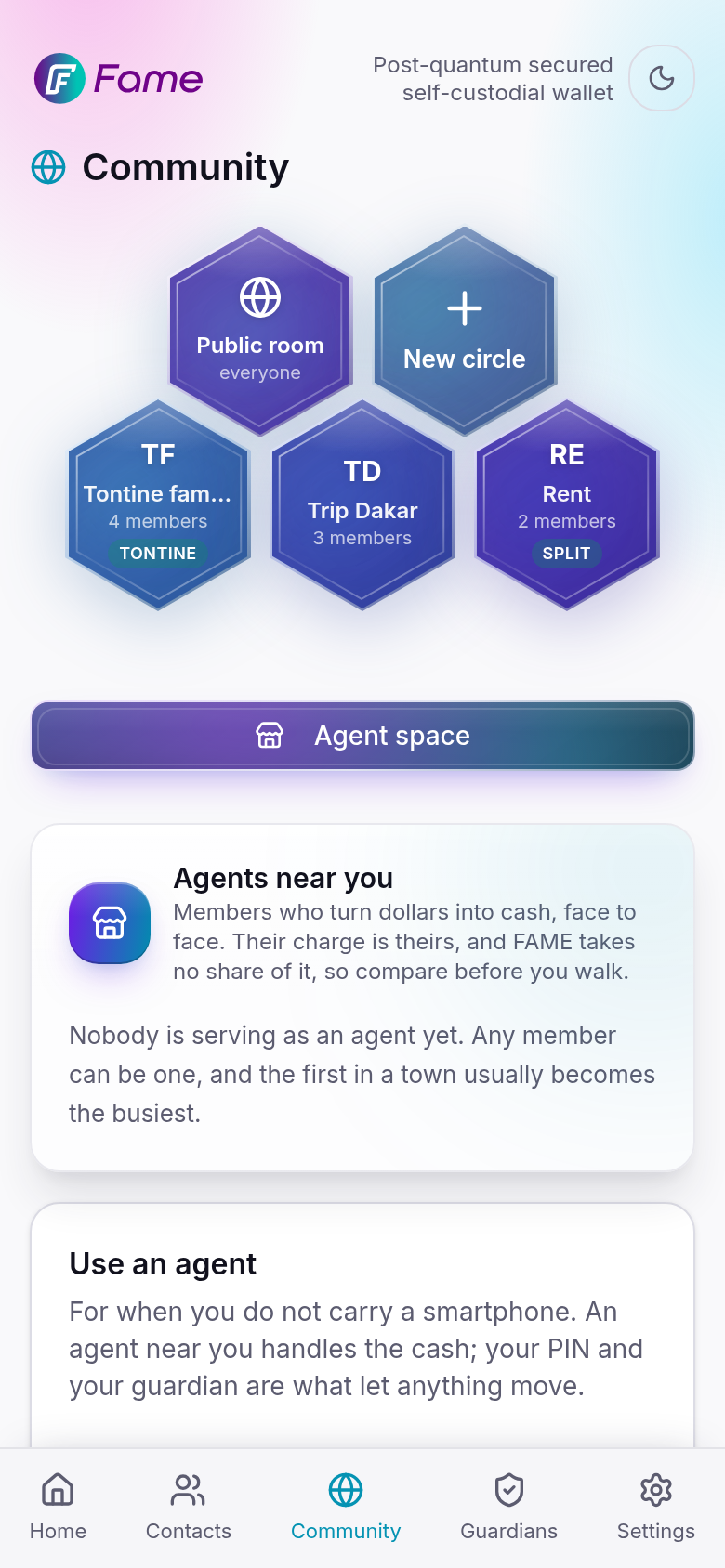
The communities FAME serves already organise money in groups: the family purse, the rotating savings club, the collection for a neighbour. FAME treats the group as the primary object. A circle is an end-to-end encrypted room where the group's money actually moves, with nobody in the middle: not a treasurer, and not FAME.
Tontine: the rotating savings club
A fixed amount, weekly or monthly; each round pays out to one member in turn. The order is fixed when the circle is created and can never be quietly rearranged. Every contribution goes straight from member to beneficiary and is verified on the public ledger.
Split: one expense, shared
Someone fronted the feast, the repair, the funeral. Each chosen participant reimburses them the same amount once, directly. No rotation, no one chasing cash door to door.
Fund-me: a goal with a door
A target the circle raises toward, and a public link so anyone can give without joining the private room. Gifts land in the organiser's own wallet as they arrive. There is no campaign balance for anyone to freeze or take.
A payment is a message
Every conversation and every circle is end-to-end encrypted with post-quantum keys. A payment is sent in the thread, its receipt verified on-chain, so the group's social record and its financial record are the same record. On Arc, a circle payment costs the member no network fee at all.
No pooled funds, anywhere
No treasurer, no FAME employee holding a contribution
Reliability is visible, never enforced
Utility: cash, through a neighbour
A son in Paris. A mother in a village.
1
He sends dollars to her, from wherever his money is
She owns no phone, so FAME gave her a number of her own, FM-4298-1357, and that is her account. He withdraws from his exchange on any of the eight networks, and it lands in her account by itself. Cost: 0.5%, minimum one cent.
2
He leaves a cash envelope
He is her guardian. An envelope approves one cash withdrawal in advance, at the local shop she already knows, revocable until it is used.
3
She walks to the shop and types her PIN
Four digits she remembers are her entire equipment. The shopkeeper's phone is the terminal, and it can do nothing without her PIN and the envelope.
4
She leaves with cash
The shopkeeper hands over the money and earns a fee the family agreed face to face. FAME charges nothing to collect cash and takes no part of the shop's fee.
At no point did FAME, the shopkeeper, or anyone else hold her money. It moved from his account to hers to the shopkeeper's, each step signed by its owner, each step on the public record, final in about a second.
FAME never recruits an agent
FAME never assigns a territory
FAME never finances a cash float
FAME never takes a cut of the agent's fee
The foundation
The dollar got its own network. FAME moved in.
runs on
The blockchain built by Circle, the issuer of the USDC dollar.
Mainnet since 16 September 2026 · chain 5042 · USDC is the network's own currency
USDC
The only currency on Arc, for money and for network fees. FAME's paymaster pays the fee on every member payment.
~1 s
A payment is final. No waiting for confirmations.
8
Networks that reach one FAME address, through Circle's own protocol.
On Arc the dollar is also the network's own currency: there is no second token to hold for fees, and FAME pays the fee for every member. A payment is final in about a second and costs about a tenth of a cent, which FAME covers. In September 2026 FAME moved from Algorand to Arc, and with it every member's account.
Arc is validated by
The institutions that run the network
Block production on Arc is restricted to a fixed group of regulated financial institutions. These are Arc's founding validators as announced by Circle at the mainnet launch.
They validate the network FAME settles on. They are not partners, customers or investors of FAME.
The move, from 15 October
Why we moved, and what it asks of you
FAME was built on Algorand and moved real dollars there for a year. Then Circle, the company that issues the dollar, built a network of its own, and three things about it were decisive. On Arc the dollar is the network's own currency, so a member never has to hold a second token for fees, and FAME can pay those fees. Arc sits inside Circle's transfer protocol, so one FAME address reaches seven more networks and every exchange that lists them. And the network is validated by the institutions the world already trusts with its payments. A dollar account belongs on the dollar's network.
One screen. Nothing moves without you.
1
You confirm, with your password
The app creates your account on Arc and seals it under the same password and the same fingerprint or face. Your guardians are re-sealed to the new key before anything switches.
2
Your dollars come with you
Bring them now, from your old wallet, or later from any exchange on any of the eight networks. FAME pays the cost of the move. There is no bonus and no fee waiver: members pay FAME's fee as always.
3
Your old wallet keeps withdrawing
Indefinitely. Nothing is ever trapped. Members with no smartphone move at their agent's counter with their PIN, in one visit.
What changes
No coin to buy for network fees: on Arc the fee is in USDC and FAME's paymaster pays it.
One address that receives from eight networks.
Organisations pay up to 200 people in one operation.
What does not
Your guardians, your envelopes, your PIN, your agent.
Your chats and circles, end-to-end encrypted.
Self-custody: FAME still holds no key to your money.
Our story
From a farmers' marketplace to the dollar's own network
Four years, one mission: money that stays in the hands of the person who earned it. The tools changed. The promise did not.
2022
Food Autonomy
FAME began as a marketplace for farmers: Food Autonomy and Mutual Empowerment. Sell the harvest, get paid, keep the money.
The lesson
The problem under the food problem was money
The farmers taught us that getting paid, keeping it and moving it, without a bank willing to serve them, was the real problem. The F changed meaning: Financial. The mission stayed.
2025 to 2026
A dollar account nobody but its owner can touch
Keys that survive a quantum computer, guardians instead of a password reset, chats and circles that are encrypted end to end, and cash at a neighbour's shop for a person with a basic phone. Live, with real money.
September 2026
The dollar got its own network
Circle, the issuer of USDC, launched Arc, validated by Visa, Mastercard, BlackRock, DTCC and MoneyGram. FAME moved in the same month. New accounts open on Arc.
15 October 2026
Every member moves
The move opens for every member. One screen, the same password, your guardians re-sealed, your dollars with you. FAME pays the cost of the move.
Security
Nobody can move money alone.
Most systems protect money by trusting one institution completely. FAME splits that trust between people and mathematics, so there is no single door for a thief, an employee, or FAME itself.
The member
Their PIN and their keys
Their guardian
Approves cash in advance
Their agent
A terminal, never a custodian
Moving money needs more than one of them. Stealing it would need all of them.
A stolen agent phone opens nothing. A shoulder-surfed PIN opens nothing. FAME's own servers, fully compromised, could refuse to relay a payment but never write one. Every movement settles on a public ledger, auditable by anyone, forever. And the honest limit, stated rather than hidden: a member's guardian and their agent colluding is the residual risk, which is why the member chooses both, and can replace both, freely.
Technology
Only four choices matter.
Self-custody, always
Keys are created and used on the member's side. Servers store ciphertext and relay signed operations. This is not a policy that could change. It is all the software is able to do.
Dollars, not tokens
Balances are USDC: a dollar amount people already understand, with no exchange rate to explain to a family, and on Arc no second token to pay for anything.
Arc settlement
Final in about a second. The network fee, about a tenth of a cent, is charged in USDC and paid by FAME's paymaster. Validated by regulated financial institutions, inside Circle's transfer protocol.
Post-quantum encryption, today
Chats, circle keys and guardian recovery shares are sealed with hybrid X25519 + ML-KEM-768, the design Signal, Apple and Chrome now ship. Accounts are built to adopt post-quantum signatures the day the network can verify them, without moving.
The Arc stack
What FAME runs on, and who pays the network fee
Every blockchain charges a network fee in its own coin: Ethereum, Base, Arbitrum and Optimism charge in ETH, Polygon in POL, Avalanche in AVAX, Monad in MON. A FAME member never holds any of them. On those seven networks FAME pays the fee in USDC, taken out of the amount, through a paymaster contract. On Arc the fee itself is charged in USDC, about a tenth of a cent per payment, and FAME's own paymaster pays it for every member.
Arc, Circle's Layer 1
An EVM-compatible blockchain built by Circle, the issuer of USDC. Consensus is Malachite BFT, run by a fixed set of regulated financial institutions. A block every half second, final in one block. USDC is the native currency, so network fees are priced in dollars (EIP-1559), about a tenth of a cent per transfer. Chain id 5042.
Smart accounts (ERC-4337, Kernel v3.1)
A member's account is a smart contract whose address is computed from their own key, so it is identical on all eight networks and only that key controls it. Its signature verifier is a module that can be replaced without changing the address, which is how the account will adopt post-quantum signatures when the network can verify them.
FAME's paymaster on Arc
An ERC-4337 paymaster contract FAME deployed on Arc. It pays the network fee, in USDC, for every member payment, withdrawal and transfer out, and refuses anything that is not exactly a member's own payment carrying FAME's fee. It is owned by the founder's own account, never by a server key.
Fees in USDC on the other seven networks
Ethereum, Base, Arbitrum and Optimism charge fees in ETH, Polygon in POL, Avalanche in AVAX, Monad in MON. When a member's dollars come home from one of them, an ERC-20 paymaster (Pimlico) takes that fee in USDC out of the amount, so the member never buys or holds any of those coins.
Circle's transfer protocol (CCTP v2)
USDC sent to a FAME address on another network is burned there and minted on Arc by Circle itself, with Fast Transfer in seconds: no bridge pool, no wrapped token, nobody holding dollars in between. A one-time permission, a session key with a call policy on the member's account, lets FAME's relayer do only that move and nothing else.
Safe 2-of-3 for organisations
An organisation's treasury is a Safe contract on Arc held by three named officers, two signatures on every release, nobody alone, FAME included. One operation pays up to 200 people, and every line carries its own transaction id on the public explorer.
Every movement settles on Arc and is public on explorer.arc.io.
The category
Four systems. One keeps the money yours.
Bank
Mobile money
Crypto wallet
FAME
Who holds the money
The bank
The operator
You
You
Works without a smartphone
At a branch
Via their agents
No
Yes, through people you trust
Receives from other networks
No
No
One network per wallet
Eight, one address
Lost phone or password
ID at a branch
The operator decides
Money gone
People you chose bring you back
Cost to send money
Fees plus spread
1 to 3%
Variable gas
0.5% (min $0.01), network fee on Arc paid by FAME
Anyone can freeze you
Yes
Yes
No
No
Questions
What is Arc, and why did FAME move there?
Arc is the network built by Circle, the company that issues the USDC dollar. On Arc the dollar is also the network's own currency, so a member never needs a second token to pay fees, and FAME pays those fees for them. Arc is validated by institutions such as Visa, Mastercard, BlackRock, DTCC and MoneyGram, and it sits inside Circle's transfer protocol, which is what connects one FAME address to seven more networks.
What happens to my account on October 15?
Nothing moves without you. From October 15 every existing member is walked through a one-screen move: the app creates your account on Arc under the same password, your guardians are re-sealed, and your dollars come with you. The window stays open for 30 days. Your old wallet keeps withdrawing indefinitely, and FAME pays the cost of the move. New accounts already open on Arc.
Which networks can send me money?
Eight: Arc, Base, Polygon, Arbitrum, Optimism, Avalanche, Monad and Ethereum. You give out one address. Dollars sent on Arc land directly with no FAME fee; dollars sent on the other seven come home to your account by themselves, for 0.5% plus the network cost.
Is FAME a bank or a mobile money operator?
No. FAME never holds anyone's money and cannot move it. Every account is a self-custodial wallet: the keys exist only on the member's side, and every movement is signed by the member and settled on a public ledger.
How can someone without a smartphone use digital money?
Through the people around them. A member needs only a 4-digit PIN they remember. A local shop's phone is the terminal, their guardian approves cash in advance with an envelope, and the shopkeeper hands over cash. The shop can never move the money alone.
What does it cost?
0.5% of the amount, never less than $0.01, on payments between members, withdrawals to any network, and dollars brought home from another network. Nothing to receive on Arc, nothing to collect cash at a shop, and no network fee ever on Arc: FAME pays it.
What happens when someone loses their phone or password?
The people they chose bring them back. Recovery goes through guardians: real people, picked by the member, who can restore access but can never spend the money. No seed phrases, and no support ticket to a company.
The Internet connected computers. Bitcoin connected money. FAME connects money to hands.
For organizations
Pay hundreds of people at once. Two signatures, nobody alone.
NGOs, businesses and associations run a shared dollar treasury on Arc: three officers, two signatures on every release, up to 200 people in one operation, and a flat subscription instead of a percentage. Every payment carries its transaction id, and the statement exports to CSV.




















 Mainnet since 16 September 2026 · chain 5042 · USDC is the network's own currency